

In export processes, the correct use of documents is crucial in terms of both customs procedures and legal responsibilities. Among these documents, invoice types play a leading role. Every export transaction begins with an invoice. However, this invoice is not always of the same type. Depending on the nature of the shipment, the purpose of the transaction, or the destination country, different types of invoices may be required. In this article, we explain the main types of invoices used in exports, their purposes, and their differences in simple terms.
1. Commercial Invoice
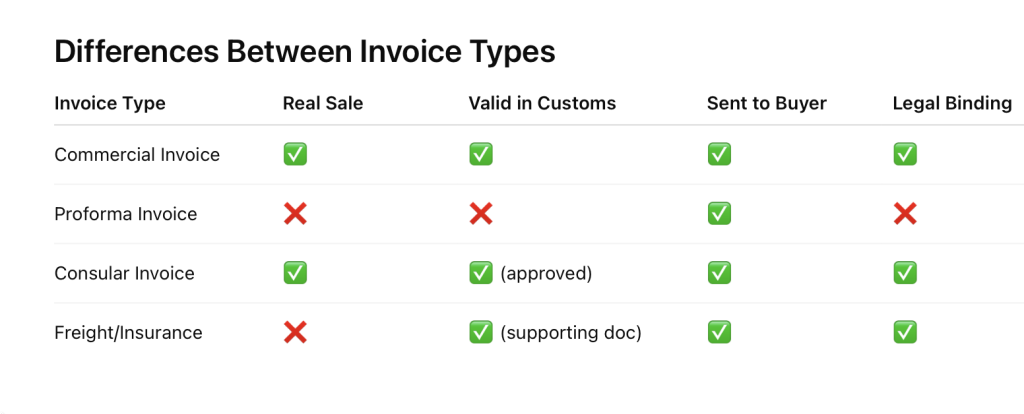
The most common and fundamental export invoice. It is the official document that proves a real sales transaction and reflects the monetary value of the goods.
Information it must include:
- Exporter and importer details
- Invoice date and number
- Product name, quantity, unit price, total value
- Currency
- Delivery terms (Incoterms)
- HS Code
- Exporter’s signature
Where is it used?
Mandatory for all official export procedures and customs clearance. It is also accepted as a reference for tax or import processes in the buyer’s country.
2. Proforma Invoice
A pre-shipment quotation invoice. Sent to the buyer for preliminary information before the goods are shipped. It is not legally binding, but represents the offer in an official form.
Information it may include:
- Estimated price and costs
- Product specifications
- Delivery time and conditions
- Exporter’s contact details
- Process information (freight, insurance, payment terms, etc.)
Where is it used?
- When the buyer needs to obtain an import permit
- For opening a letter of credit
- For pre-orders or quotation requests
- In some incentive applications
3. Consular Invoice
Some countries may require an invoice approved by their own consulate. In this case, the commercial invoice is presented to the consulate of the relevant country and becomes a consular invoice.
Who requires it?
Government authorities in certain regions, such as the Middle East and Africa, impose this requirement to maintain strict customs procedures.
4. Freight Invoice
An invoice that shows the transportation costs, usually issued by the logistics company.
When is it used?
- If the freight cost is to be paid by the buyer, this invoice is attached to the shipment.
- When a separate declaration other than the commercial invoice is requested.
5. Insurance Invoice
In some export transactions, cargo is insured. In such cases, in addition to the insurance policy, a separate invoice showing the insurance premium may be issued.
6. Tax-Exempt Invoices
Exports from Turkey are exempt from VAT. Therefore, invoices must include the statement:
“In accordance with Article 11 of the VAT Law No. 3065, VAT has not been calculated.”
Which Invoice Should Be Used and When?
- Initial offer stage: Proforma invoice
- Official shipment and customs clearance: Commercial invoice
- Public procurement abroad / specific requirement: Consular invoice
- When freight and insurance costs are separate: Freight and insurance invoice
Common Mistakes Made by Exporters
- Attempting to use a proforma invoice for customs clearance
- Leaving out critical information such as HS Code or delivery terms in the commercial invoice
- Not including the VAT exemption statement
- Not specifying the currency
- Invoice language and format not complying with the buyer country’s regulations
Conclusion
Using the correct type of invoice at the right stage of the export process prevents delays at customs, legal issues, and customer dissatisfaction. At the core of every export lies a proper flow of documentation, and the invoice is the backbone of this flow.
At Solmaz Express, we support you in proper invoicing processes for your export operations and ensure your documents are fully compliant with customs regulations. Get a quote from us today to access the reliable and professional support you need to expand internationally.